How to shortlist 200 resumes in a day
By the HR Mitra team · 4 October 2026 · 4 min read
A popular opening can bring in a couple of hundred CVs. Read carefully, at five to seven minutes each, 200 resumes are 17 to 23 hours of reading: two to three working days before anyone has been called.
The method below gets you to a fair shortlist in about one day. It works because you decide what matters before you open a single CV, and because you only spend real time on CVs that can still make the list.
Step 1: Write down the must-haves first (about 30 minutes)
Sit with the job description, ideally with the hiring manager, and split it in two.
- Must-haves: three to five things nobody can do this job without. For a backend developer that might be “3 or more years building APIs in Python”, “has worked with PostgreSQL” and “can work from Pune two days a week”.
- Nice-to-haves: everything else. They break ties later; they never decide whether a CV moves on.
Make every must-have something you can check on a CV. “Strong communication” cannot be read from a resume, so it belongs in the phone screen, not here. Then agree the bar: how many must-haves a candidate needs to move on.
Step 2: Run a knock-out pass (about 30 seconds a CV)
Read each CV only for the must-haves that are yes or no: years with the core skill, location or willingness to relocate, a required certification. Put every CV in one of three piles: Yes, Maybe or No. Do not score anything yet.
At 30 seconds a CV, 200 CVs take about 100 minutes. A CV that clearly misses a must-have leaves here, and never costs you more than half a minute.
Step 3: Score the Yes pile with evidence (about 4 minutes a CV)
Now read properly. For each must-have, give a score:
- 0: no sign of it.
- 1: mentioned, for example in a skills list.
- 2: shown in their work: a project, a result, how long they did it.
Write one line of evidence next to each score, copied from the CV. “Built the payments API in FastAPI and owned it for two years” is a 2. “Skills: Python, FastAPI” is a 1. Look for what the candidate did themselves (“I designed”) rather than what their team did (“worked on”).
Step 4: Give the Maybe pile one quick look (about 2 minutes a CV)
Maybes are often CVs that say the right thing in other words: “Postgres” for PostgreSQL, “Django REST Framework” for building APIs. Read each one once against your bar and move it to Yes or No. Do not let it become a second Yes pile.
How the day adds up
Your piles will be different sizes, but as an example, with 60 Yes and 40 Maybe:
- Must-haves written down: 30 minutes
- Knock-out pass, 200 CVs at 30 seconds: 1 hour 40 minutes
- Scoring, 60 CVs at 4 minutes: 4 hours
- Maybe pile, 40 CVs at 2 minutes: 1 hour 20 minutes
- Total: about 7 hours 30 minutes
Most of the time goes on the CVs that can still make the shortlist, which is where it should go.
Step 5: Phone screen the top of the list
Take the highest scores to a short phone screen, with the same questions in the same order for everyone. Our guide to phone screening questions for software engineers has the questions and what good answers sound like.
Mistakes that cost the most time
- Matching keywords instead of reading. People describe the same skill in different words. A keyword search misses some of them and rewards CVs stuffed with terms.
- Letting the bar drift. The 150th CV gets read differently from the fifth when you are tired. Score against the written must-haves, take breaks, and re-check a few early decisions at the end.
- Weighing college or company names. They say little about whether someone can do this job. Look at what they did.
- Skipping late applicants. The last CV in the inbox deserves the same read as the first.
- Deciding without writing down why. A one-line reason per decision makes the shortlist easy to explain to the hiring manager, and easy to revisit.
Where AI screening fits
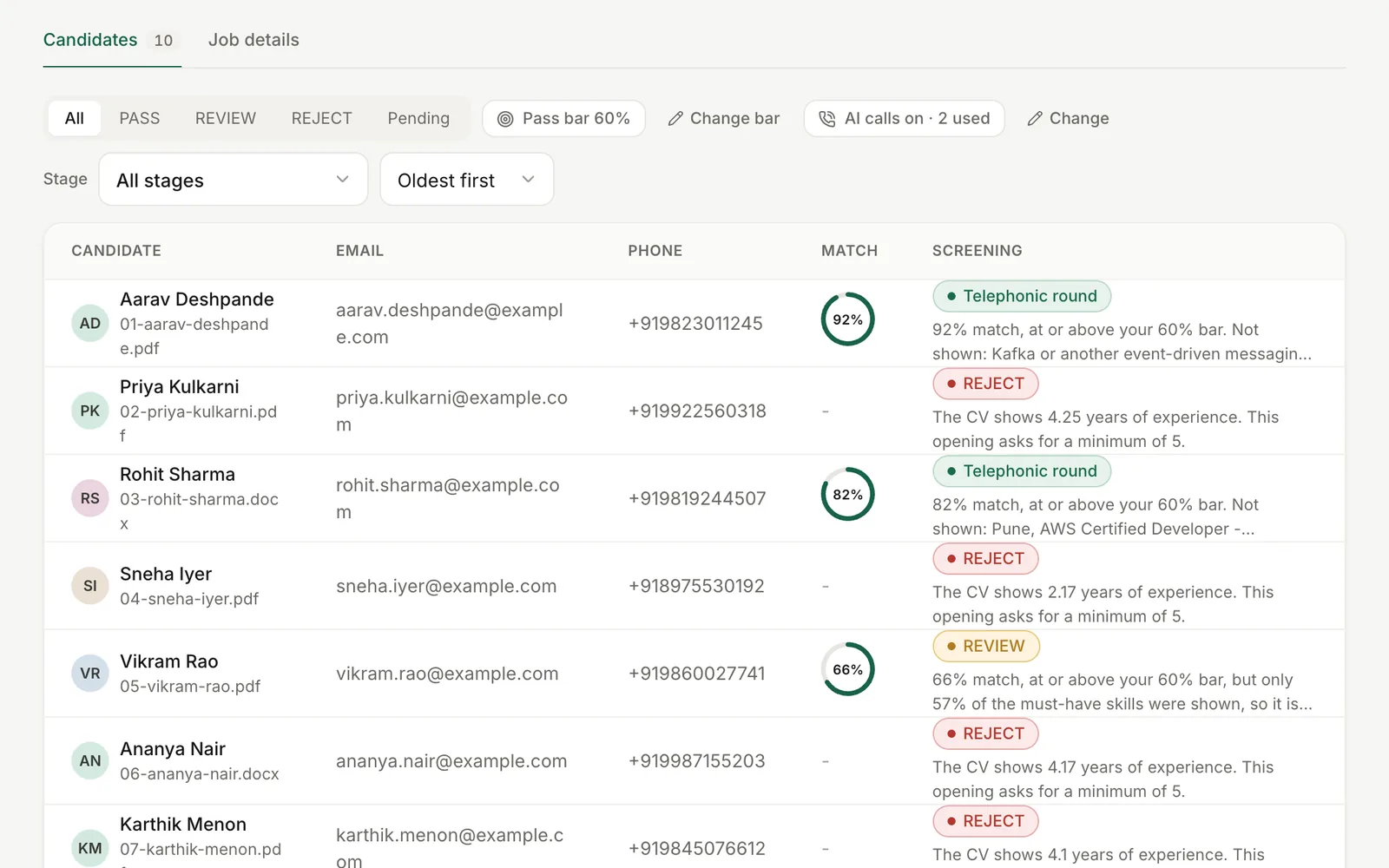
Steps 2 to 4 are the slow part: reading every CV against the same must-haves. That is the part HR Mitra does. It reads the requirements from your job description, reads each CV in full against them, and shows the lines from the CV behind every score. Candidates at or above your bar pass, those just below it come to you to review, and the rest are rejected, and you can override any result. You upload up to 100 CVs at a time, as PDF or Word files.
See how AI resume screening and bulk resume screening work.