Resume screening checklist for HR teams
By the HR Mitra team · 4 October 2026 · 3 min read
Screening goes fastest, and stays fair, when every CV is checked against the same short list. Use the checklist below as it is, or adapt it to your openings. Settle the first part once per opening, then run the second part on every CV.
Before you open the first CV
- Must-haves agreed with the hiring manager: three to five, each one something you can check on a CV.
- Nice-to-haves written down separately, so they break ties and never decide on their own.
- The bar: how many must-haves a candidate needs to move on.
- Practical limits: location and work mode, how long a notice period you can wait for, and the budget range.
- Who makes the final call, and by when.
On every CV
- Relevant experience: years with the must-have skills, not total years of work.
- Skills shown in their work, not only listed in a skills section.
- Their own contribution: what they built, decided or owned, rather than what their team did.
- Results and scope: numbers, outcomes, the size of what they worked on.
- Progression: more responsibility over time, in whatever form it takes.
- Fit with the practical limits: location or willingness to relocate if the role needs presence, and notice period if the CV states it.
Red flags worth a question, not an automatic reject
- Gaps between jobs. Ask. Study, health, family and layoffs are all common reasons, and none of them says anything about how well someone works.
- Several very short stints. Ask why. Contracts and company closures look the same on paper as quick exits.
- A skills list far longer than the experience behind it. Check the work history for where each skill was used.
- Descriptions copied from the job description. Look for specifics only someone who did the work would know.
- Dates that do not add up. Ask, since it may be a typo.
Things that should not decide
- Photo, age, gender, marital status, religion, caste or home town.
- The name of a college or a previous employer, on its own.
- The CV’s design or length.
- Minor typos, unless written communication is part of the job.
Keeping it fair and consistent
- Use the same checklist for every CV of the opening.
- Write a one-line reason for every decision.
- Screen in batches, with breaks, so the 150th CV gets the same read as the first.
- At the end, re-check a few of the rejects.
- Ask a second person to look at borderline cases.
After screening
- Move the shortlist to a phone screen with the same questions for everyone: see our phone screening questions for software engineers.
- Send the people you did not shortlist a short, polite note.
- Keep candidates’ data only as long as you need it, and delete what you no longer need.
How HR Mitra applies this checklist
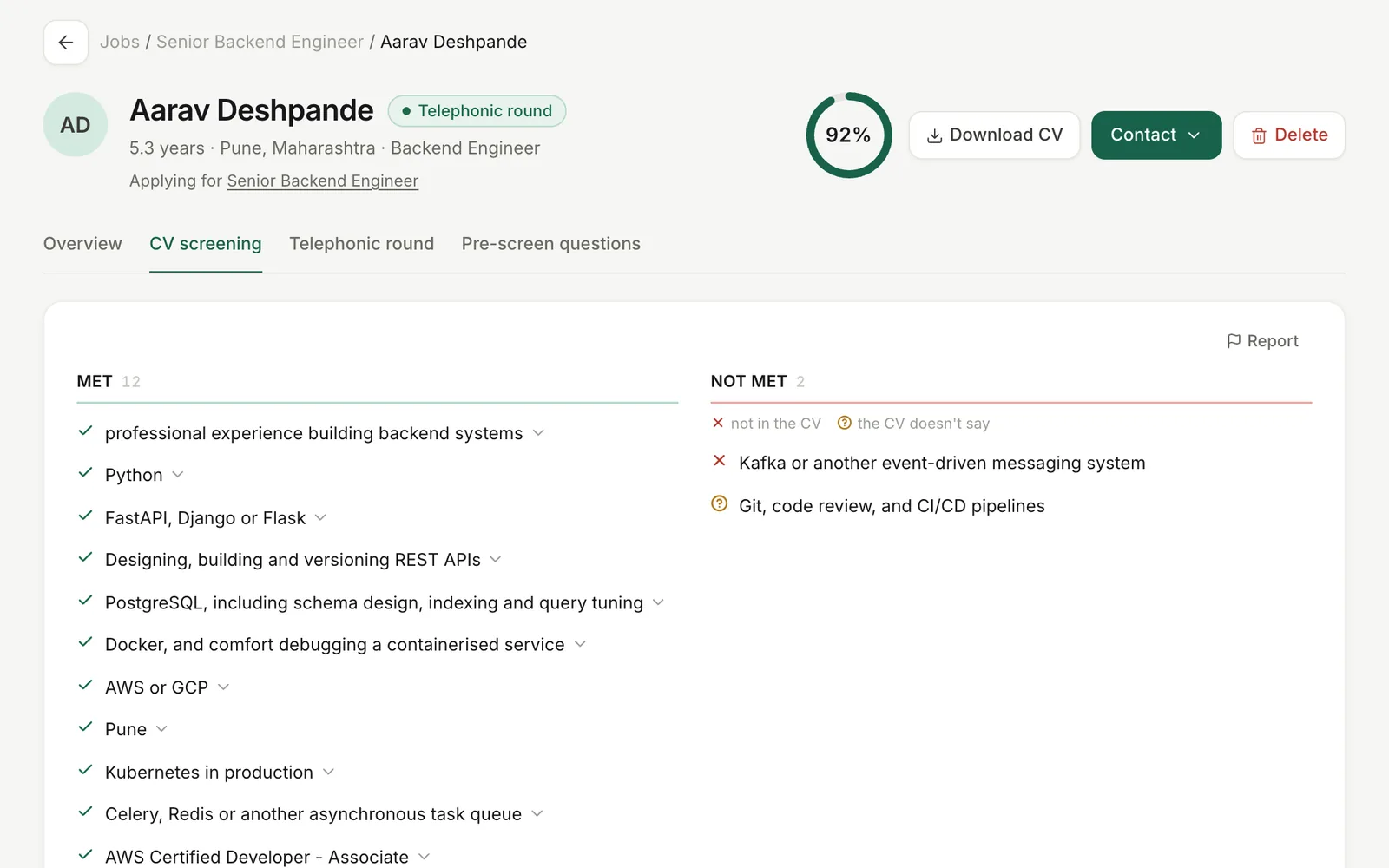
HR Mitra reads the requirements from your job description and marks each one required or preferred, for you to check. It then reads every CV in full against them and shows the lines from the CV behind each result. A missing required skill, or too little of the experience the role needs, can reject a candidate whatever the score, while a missing preferred one is only ever a note. You set the bar for each opening: candidates at or above it pass, those just under it come to you to review, and you can override any result. Candidate data is deleted automatically 180 days after upload.
See how AI resume screening works, or how to shortlist 200 resumes in a day by hand.