How to cut time to hire at the screening stage
By the HR Mitra team · 5 October 2026 · 3 min read
Time to hire is the number of days from a candidate applying to accepting an offer. Most of those days are not spent interviewing. They are spent waiting: for someone to open the pile of CVs, for a free slot to call people back, for feedback after a round. The screening stage is where most of that waiting happens, and where it is easiest to cut.
Why screening is slow
Take one opening with 100 CVs. Reading each one carefully takes about 6 minutes, so reading alone is 10 hours. Then the best tenth, 10 candidates, need a phone screen of about 10 minutes each, plus the time to reach them. With the decisions on top, that comes to about 12h 10m of work for one role, before the first real interview. Spread across a week of other tasks, it easily becomes two.
Meanwhile, the strongest candidates are interviewing elsewhere. A good candidate who applied on Monday and hears back the following Friday may already have an offer.
Where the days go, and how to win them back
1. Agree the must-haves before the job goes live
Every round of “actually, we also need” after screening starts sends you back through the pile. Settle three to five checkable must-haves with the hiring manager first. Our guide on writing a job description that gets better CVs shows how.
2. Screen in daily batches, not one big pile
Waiting for applications to close and then screening everything at once guarantees that the earliest applicants wait longest. Screen what came in each day, so a strong candidate hears from you within a day or two.
3. Use a knock-out pass
Location, notice period and the one or two hard requirements can be checked in seconds. Do that first, and spend the careful reading only on the CVs that could work. The full method is in how to shortlist 200 resumes in a day.
4. Stop chasing phone screens
Scheduling is the slowest part of phone screening: missed calls, call-backs, candidates who can only talk after work. Offer candidates a way to do the first screen when it suits them, or block fixed calling hours and send slots rather than calling cold. Keep the questions the same for everyone; our pre-screening questions are a good start.
5. Book interview slots before you need them
Ask the hiring manager for two or three fixed interview slots a week while the job is open. When a candidate clears the screen, offer one of those slots the same day, instead of starting a new round of calendar messages.
6. Decide in a day
Agree with the hiring manager that feedback after each round comes within one working day. A written scorecard against the must-haves makes that quick: the decision is mostly made by the time the interview ends.
Measure it
Track two dates for every hire: when they applied and when they accepted. Then look at where the gaps are longest. If most of the time sits between applying and the first call, screening is your bottleneck, and the steps above will help most.
How HR Mitra shortens the screening stage
HR Mitra screens a batch of CVs within minutes of upload, and candidates who pass get an AI phone screen link by themselves, which stays open for 10 days. They take the call when it suits them, and you get the result without scheduling anything. For the same 100 CVs, your own time comes to about 55 minutes, against about 12h 10m by hand.
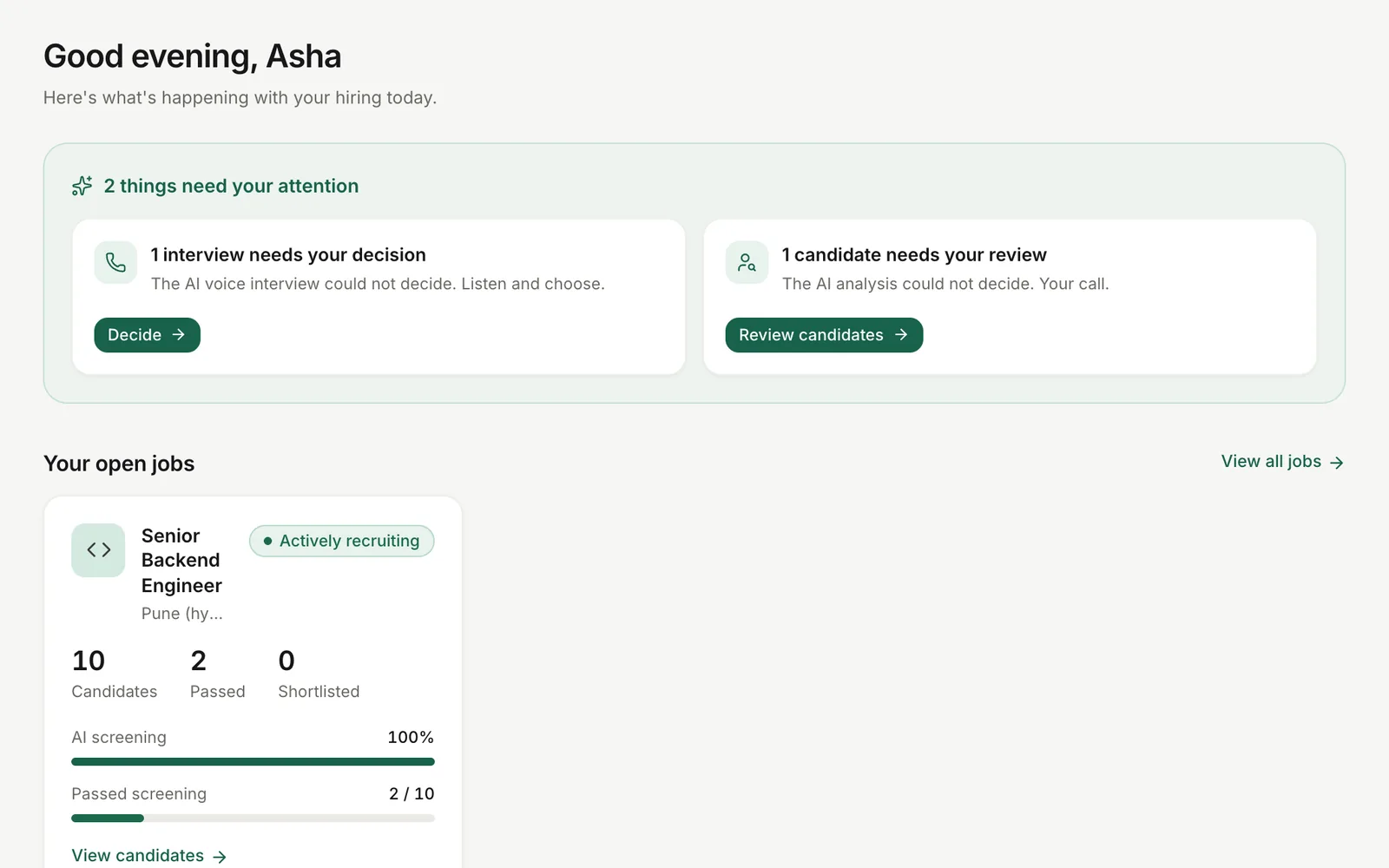
See how bulk resume screening and AI phone screening work together.