How to write a job description that gets better CVs
By the HR Mitra team · 5 October 2026 · 3 min read
Most screening problems start before the first CV arrives. A job description that lists fifteen “requirements”, half of them wishes, brings in hundreds of CVs that match none of them well, and leaves you deciding what the role really needs while you screen. A clear one does the opposite: fewer, better applications, and a screen that almost runs itself.
Start with the work, not the title
Titles mean different things at different companies. A “Senior Executive” can be a fresher’s first promotion or a team lead. Before you write anything, ask the hiring manager three questions:
- What will this person spend most of their week doing?
- What should they have delivered by the end of their first six months?
- What has gone wrong with people in this role before?
The answers give you the opening paragraph of the description and, more importantly, the real must-haves.
Separate must-haves from nice-to-haves
This is the single change that improves CV quality most. Keep the must-haves to three to five, and make each one something you can check on a CV:
- Checkable: “2+ years building REST APIs in Java”, not “strong backend skills”.
- Truly required: would you reject an otherwise great candidate without it? If not, it is a nice-to-have.
- About ability, not background: the skill a degree is meant to prove, rather than the degree itself, unless the role legally needs it.
Put the nice-to-haves in their own list, clearly labelled. Candidates who meet the must-haves but only some of the extras will still apply, and they are often the best hires.
Be specific about experience
“3 to 5 years” of what? Total years of work tell you little. Write the years against the skill: “at least 2 years of B2B inside sales” or “1 year handling payroll for 200+ employees”. It saves you from reading CVs with eight years of unrelated work, and it tells a strong candidate with four focused years that they qualify.
State the practical details
Candidates in India filter on these before anything else, and leaving them out fills your pile with people who will drop out at the offer stage:
- Location and work mode: the city, and whether the role is on-site, hybrid or remote.
- Notice period: how long you can wait, if it matters. “Immediate joiners preferred” is fine when it is true.
- Salary range: even a broad band cuts out the applications that were never going to work.
- Shifts or travel, if the role has them.
Cut what does not help
- Generic traits: “team player”, “self-starter” and “excellent communication skills” are in every description and on every CV. Say what the communication is: “explains delays to clients over the phone”.
- Long lists of tools. If someone knows two of the five, will they learn the rest in a month? Then list the two.
- Words that put people off for no reason: “young”, “rockstar”, a gender, an age limit or a specific college.
A simple structure
- About the role, two or three sentences on what the person will do and why it matters.
- What you will do, four to six bullet points.
- Must-haves, three to five, checkable.
- Nice-to-haves, labelled as such.
- Practical details: location, work mode, notice period, salary range.
- How to apply and what happens next.
Use the same list to screen
The must-haves you wrote are your screening checklist. Check every CV against them, in the same order, and the nice-to-haves only break ties. Our resume screening checklist covers the rest.
How HR Mitra uses your job description
When you add an opening, you upload the job description as a PDF or Word file, or paste it. HR Mitra fills in the opening from it, the title, location, salary, experience and notice period, and reads out what the role needs: skills, years of experience, location and certifications, each marked required or preferred, for you to check before any CV is screened. A CV missing a required one can be rejected whatever its score, and a missing preferred one is only ever a note. A description with a clear must-have list gives you a sharper shortlist.
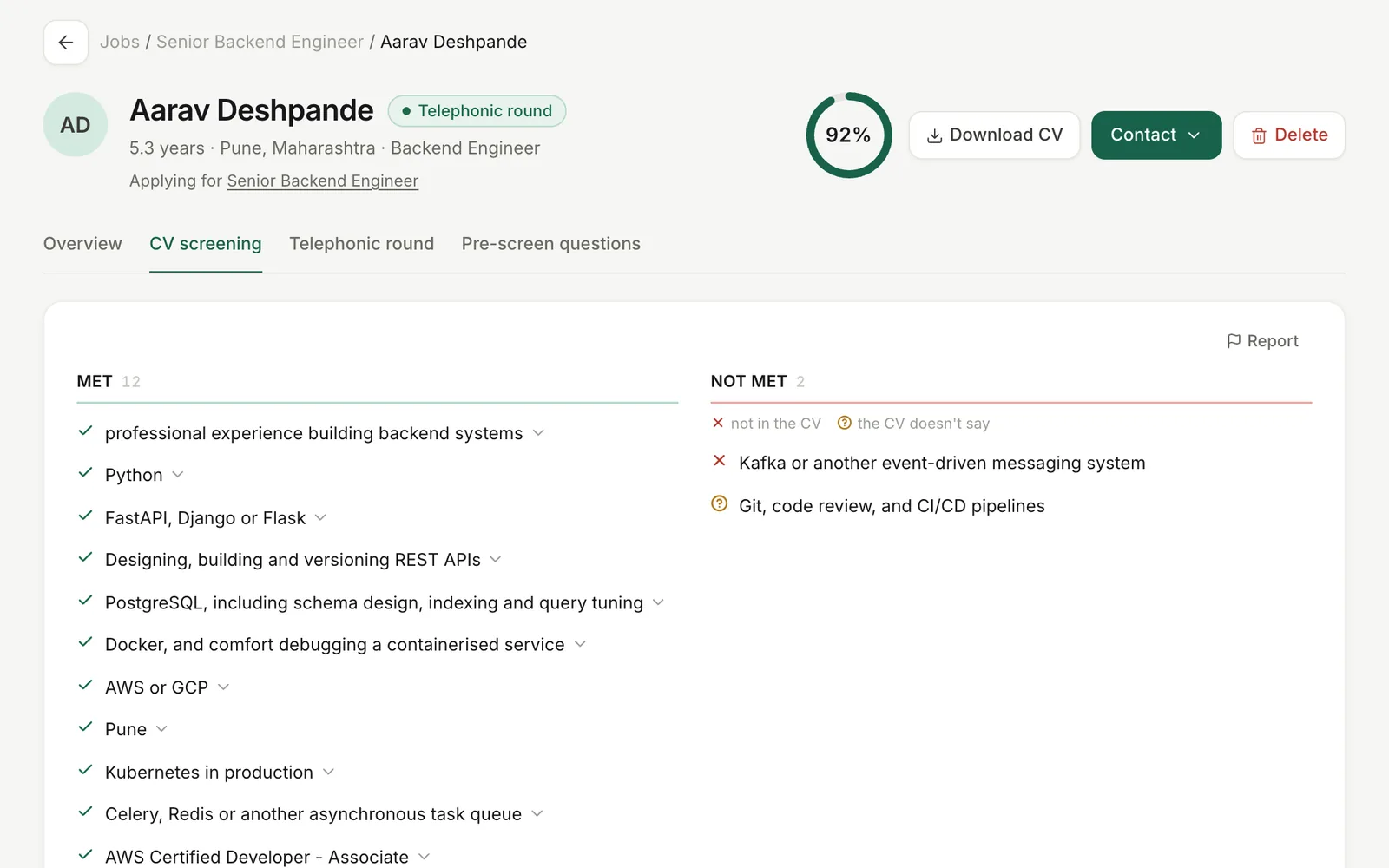
See how AI resume screening reads every CV against those requirements.