Phone screening questions for software engineers
By the HR Mitra team · 4 October 2026 · 5 min read
A phone screen is a short call between the CV and the technical interview. Its job is narrow: confirm the CV holds up when the candidate talks about it, check the basics the role needs, and settle practical details like notice period and pay. Done well, the hiring manager only spends interview time on people who can do the job.
You do not need to be an engineer to run a good one. Ask everyone the same questions, in the same order, and listen for specifics: names of things they built, problems they hit, what they did themselves.
How to structure a 15-minute call
- Introduce yourself, the role, and check it is a good time: 1 minute.
- Their current role and most recent project: 3 to 4 minutes.
- Two or three technical questions that match the role and their CV: 5 to 6 minutes.
- Why they want a change, notice period and pay: 2 to 3 minutes.
- Their questions for you: 1 to 2 minutes.
Questions about their current work
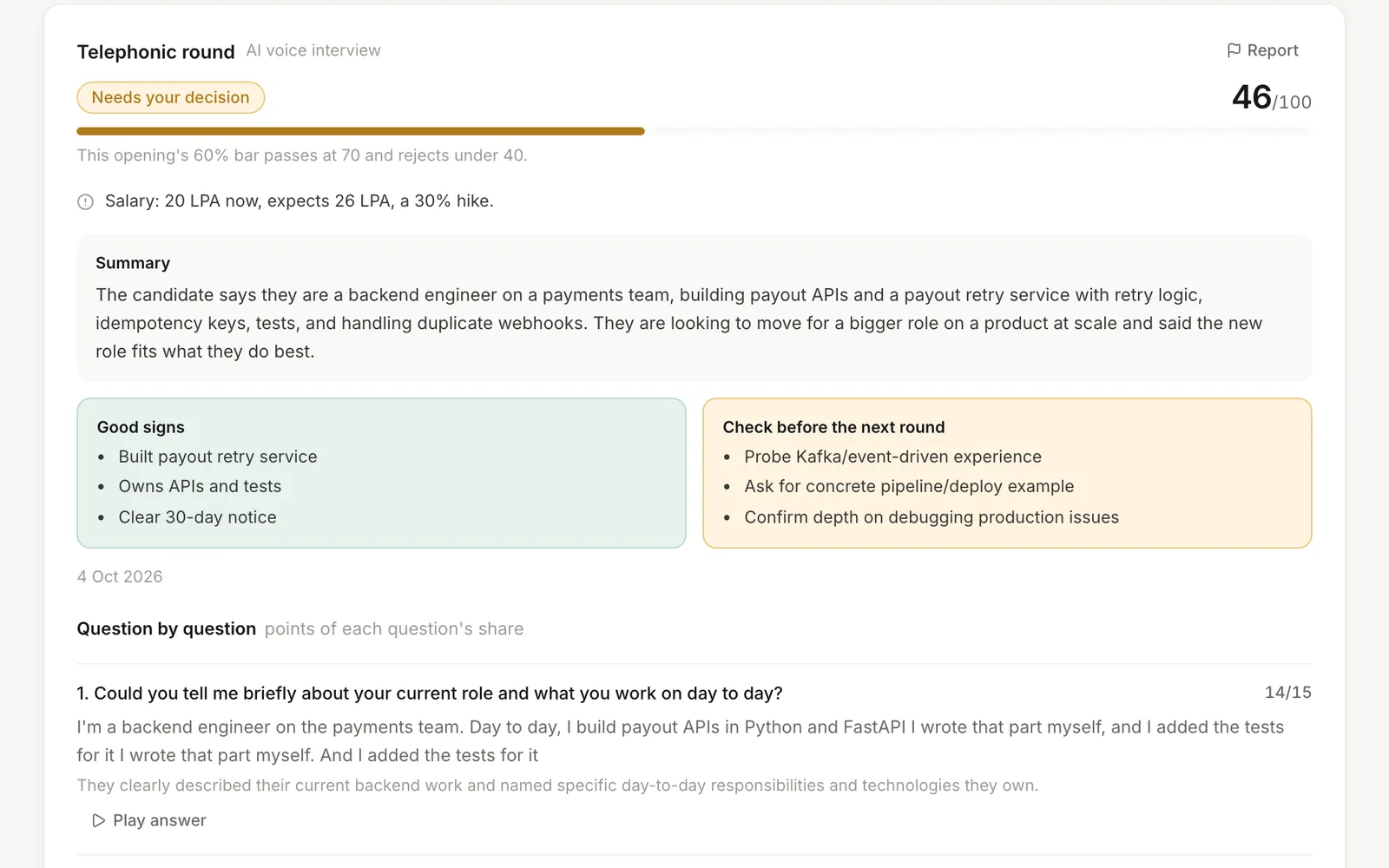
1. “Could you tell me briefly about your current role and what you work on day to day?”
- Strong answer: names the product, their part in the team, the tools they use every day, and gives one concrete example.
- Weak answer: only a job title, or "we work on many things" with nothing they did themselves.
2. “Tell me about the most recent project you worked on, and what you did on it yourself.”
- Strong answer: says "I", not only "we": what they designed, built or decided, and how it turned out.
- Weak answer: describes the project in detail but never their own part in it.
Technical questions
Pick two or three that fit the role and what the CV claims.
3. “You mention [a technology] on your CV. What did you build with it, and what was hard about it?”
- Strong answer: a specific feature, a problem they ran into, and how they solved it.
- Weak answer: definitions that could come from the documentation, with no example of their own.
4. “Tell me about a bug in production you helped fix. How did you find the cause?”
- Strong answer: the logs or metrics they checked, how they reproduced the problem, the root cause, and what they changed so it does not happen again.
- Weak answer: "we restarted the server", or blame without any detail.
5. “How do you test your code before it goes out?”
- Strong answer: tests they write themselves, such as unit tests for the logic and some integration tests, a named tool (pytest, JUnit, Jest), code review, and tests running before a merge.
- Weak answer: "QA tests it", with nothing of their own.
6. “An API you own has become slow. What do you check first?”
- Strong answer: measuring before changing anything: which endpoint is slow, which database query, whether an index or a cache is missing, and checking the fix with numbers.
- Weak answer: jumping to "add more servers", or a rewrite, without measuring first.
7. “A fix you deployed is failing in production. What do you do?”
- Strong answer: limit the damage first by rolling back or switching the change off, tell the team, then find the root cause and add a test for it.
- Weak answer: keeps patching the live system with no way back.
Motivation and practical details
8. “Why are you looking for a change?”
- Strong answer: clear reasons tied to the work: scope, technology, growth. Better pay is a fair reason too.
- Weak answer: no reason at all, or only complaints about their current employer.
9. “What is your notice period?”
Note the exact number of days, and whether it can be shortened or bought out. Long notice periods are common in Indian tech companies, so it is worth knowing early whether this one fits your timeline.
10. “What is your current CTC, and what are you expecting for this role?”
Write down both numbers, and how much of the current figure is fixed if that matters for your budget. Do not negotiate on a phone screen: record it, and leave the offer to the hiring team.
Questions to avoid
Do not ask about age, marital status, plans for children, religion, caste, or health that has nothing to do with the job. None of it tells you whether someone can do the work, it invites bias into the decision, and it can lead to discrimination complaints.
How to score the call fairly
- Ask every candidate the same questions in the same order.
- Write down what they said, not your impression of them.
- Rate each area, for example from 1 to 5, against what a strong answer looks like above.
- Decide after the call, not during it.
- If two people run screens, agree first on what a strong answer sounds like.
Screening every candidate without making every call
HR Mitra runs this call for you. When a candidate clears your bar on the resume screen, they are emailed a link and take the call in a browser on their phone or laptop, for up to 10 minutes. Our AI interviewer asks about their current role and a recent piece of their work, four questions about the work written from your job description and their CV, why they want a change, their notice period and their current and expected CTC, every question in the same order for everyone. The call is recorded and transcribed, and you get a score with the reasons behind it.
See how AI phone screening works, or read our resume screening checklist for the step before the call.